
![BMI Calculator: Check Your Body Mass Index & Understand What It Means [2026 Guide]](https://dailytoolsblog.com/wp-content/uploads/2026/02/bmi-calculator-hero-1200x600.png)
Most people don’t think about their Body Mass Index until a doctor casually mentions it during a routine checkup.
That’s usually when the question appears:
“Is my weight actually healthy for my height?”
The number on the scale alone doesn’t answer that. A 70 kg person might be perfectly healthy at one height — and overweight at another. That’s where BMI becomes useful.
This guide explains what BMI is, how it’s calculated, what the categories mean, and how to interpret your result realistically. If you haven’t checked your number recently, you can use this BMI calculator in just a few seconds.
What Is BMI?
BMI stands for Body Mass Index. It’s a screening measurement that compares your weight to your height.
Health professionals use it because it’s:
- Quick
- Inexpensive
- Standardized
- Useful for identifying potential weight-related risk
It does not directly measure body fat. Instead, it estimates whether your weight falls within a range that is generally associated with lower or higher health risk.
How BMI Is Calculated
The formula is simple:
BMI = Weight (kg) ÷ [Height (m)]²
In practical terms:
- Convert your height into meters
- Square that number
- Divide your weight by the squared height
Example
If someone weighs 68 kg and is 1.70 meters tall:
Height squared = 1.70 × 1.70 = 2.89
BMI = 68 ÷ 2.89 = 23.5
A BMI of 23.5 falls within the normal range.
You don’t need to calculate this manually — the tool above does it instantly — but understanding the formula helps you see what’s actually happening behind the number.
BMI Categories Explained
Your BMI will fall into one of four standard ranges:
Underweight: Below 18.5
Normal weight: 18.5 – 24.9
Overweight: 25.0 – 29.9
Obese: 30.0 and above
These ranges are based on international health guidelines and large population studies.
Generally:
- Lower BMI values may suggest insufficient body weight or nutritional concerns.
- Higher BMI values are associated with increased risk of conditions like type 2 diabetes, heart disease, and high blood pressure.
But interpretation matters.
Two people with the same BMI may not have the same health profile. Context is important.
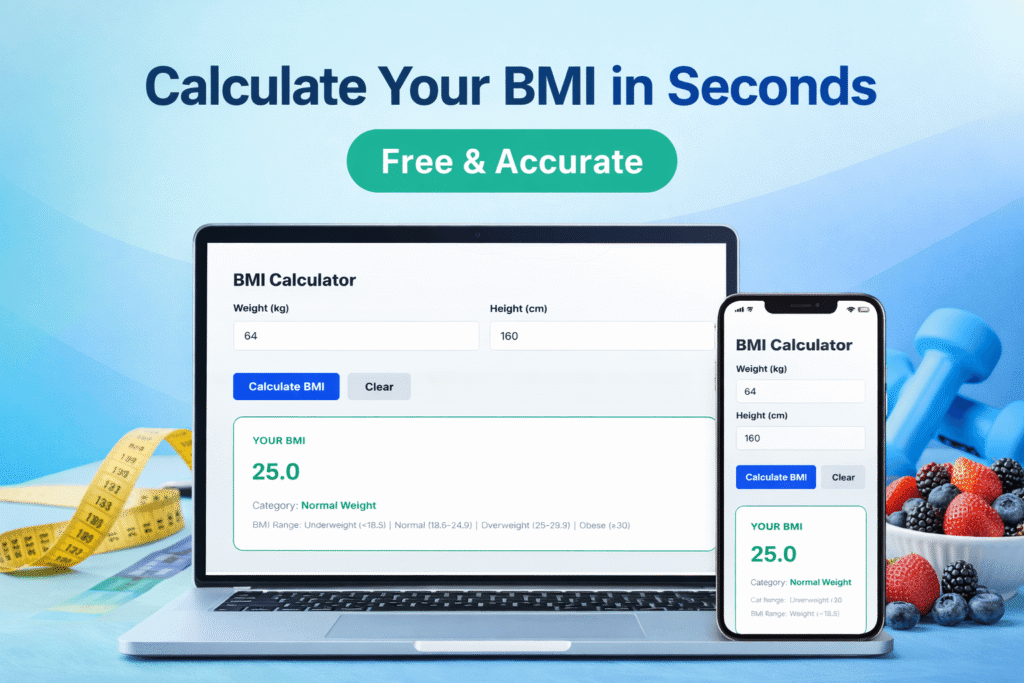
Where Do You Stand?
Reading BMI ranges is one thing. Knowing your own number is another.
If you haven’t checked recently, it takes less than 10 seconds.
Enter your height and weight in our BMI calculator tool. See where you fall. Then continue reading to understand what that number might mean for you.
What Your BMI Result Might Indicate
Let’s look at how BMI plays out in real-life situations.
If Your BMI Is Below 18.5
This may indicate underweight status.
Possible contributing factors include:
- Low calorie intake
- High metabolism
- Chronic stress
- Underlying medical conditions
Being underweight isn’t just about appearance — it can affect immunity, bone density, and overall energy levels.
Gradual weight gain through balanced nutrition and strength training is usually more sustainable than simply increasing calorie intake randomly.
If Your BMI Is Between 18.5 and 24.9
This range is generally associated with the lowest overall health risk for most adults.
If your BMI falls here:
- Maintain consistent physical activity
- Focus on whole, minimally processed foods
- Monitor your weight every few months
Stability matters more than chasing perfection.
If Your BMI Is Between 25 and 29.9
This is considered overweight.
At this stage, risk for metabolic conditions begins to increase — especially if excess weight is concentrated around the abdomen.
Even modest weight loss (5–10% of body weight) can significantly reduce long-term health risk.
Small changes — like walking daily or reducing sugary drinks — often have more impact than extreme diets.
If Your BMI Is 30 or Higher
This falls into the obese category.
At higher BMI levels, risks increase for:
- Cardiovascular disease
- Type 2 diabetes
- Sleep apnea
- Joint degeneration
Medical guidance is recommended if BMI is significantly elevated. Structured, supervised weight management tends to be safer and more effective than rapid self-directed weight loss attempts.
BMI Is Useful — But Not Perfect
BMI works well as a population-level screening tool. But it has limitations.
It may be less accurate for:
- Athletes with high muscle mass
- Older adults with reduced muscle
- Pregnant women
- Children and teenagers (who require age-specific charts)
For example, a muscular athlete may register a BMI in the overweight range while having very low body fat. On the other hand, someone with a “normal” BMI could still carry excess visceral fat.
BMI is a starting point — not a diagnosis.
BMI for Men vs Women – Is It Different?
The formula is the same for both.
However, women naturally carry a slightly higher percentage of body fat compared to men at the same BMI. That doesn’t automatically mean higher health risk — body composition and fat distribution matter.
In adults over 65, slightly higher BMI ranges (around 25–27) may not carry the same risk seen in younger adults. Muscle loss with aging changes the interpretation slightly.
How Often Should You Check Your BMI?It depends on your situation.
- If actively losing or gaining weight: every 2–4 weeks
- If maintaining: every 3–6 months
- After major lifestyle changes: recheck monthly
Daily tracking isn’t necessary. Trends over time are more meaningful than daily fluctuations.
BMI vs Other Health Indicators
BMI is only one piece of the puzzle.
Other useful measurements include:
- Waist circumference (abdominal fat risk)
- Blood pressure
- Fasting blood sugar
- Lipid profile (cholesterol levels)
Combining BMI with waist measurement often gives better insight. Excess abdominal fat carries higher metabolic risk, even when BMI is borderline.
Frequently Asked Questions
Is BMI accurate for everyone?
No. It works best for average adults but can be misleading in highly muscular individuals or older adults with low muscle mass.
Can you have a normal BMI but still be unhealthy?
Yes. This is sometimes referred to as “normal-weight obesity” — where body fat percentage is high despite a normal BMI.
What is considered the ideal BMI?
For most adults, 18.5 to 24.9 is considered healthy. Many studies suggest that values between 21 and 23 are associated with lower long-term mortality risk.
Does muscle affect BMI?
Yes. Muscle weighs more than fat, which can elevate BMI even in physically fit individuals.
Final Thoughts
BMI won’t tell you everything about your health. But it can tell you where to start.
It provides a quick reference point — a signal that either reassures you or suggests it may be time to pay closer attention to your habits.
If you haven’t checked your number recently, use our BMI calculator. Once you know your range, you can decide whether any changes make sense for your goals and health.
Last Updated: February 2026
Disclaimer: This content is for informational purposes only and does not replace professional medical advice. Consult a healthcare professional for personalized guidance.







Comment Guidelines