
Imagine this: Rahul, a 34-year-old middle-class IT worker in Pune, finally secured his dream 2BHK flat in 2021. He took out an SBI MaxGain home loan of ₹52,45,000 at a seemingly comfortable floating interest rate of 6.70%. For the first year, his monthly EMI of ₹39,724 slipped smoothly out of his salary account. He managed his family expenses, SIPs, and even saved a little extra. Then the Reserve Bank of India (RBI) started aggressively hiking the repo rate to tame inflation.
Within eighteen months, his loan’s effective interest rate shot up to 8.95%. Shockingly, his EMI didn’t change immediately. Instead, his bank quietly extended his loan tenure. What was originally a 20-year commitment silently morphed into a 27-year financial burden. When Rahul finally logged into his loan portal to check his statement, he realized almost his entire monthly payment was being swallowed by interest, and his principal was barely shrinking. This is the silent trap of the Indian home loan market, and it catches millions of borrowers off-guard.
Navigating this unpredictability requires more than just hoping interest rates drop again.
It demands precise mathematical forecasting. Using a reliable Floating Interest Rate Calculator India is the only way to stop guessing and start seeing the exact monetary impact of these macroeconomic shifts on your personal household budget.
You can also check your Floating Interest rate change effect of your existing loan EMI with our Advanced Loan EMI Calculator where you can select the reducing balance EMI method, then the option of moratorium period, multi stage disbursements phases, and floating interest option.
The Ultimate Guide to Floating Interest Rates in India
In the Indian banking system, almost all home loans and many education or property loans are issued on a floating rate basis. Unlike a fixed-rate loan where the interest percentage is locked in for the entire tenure, a floating rate fluctuates based on an external benchmark.
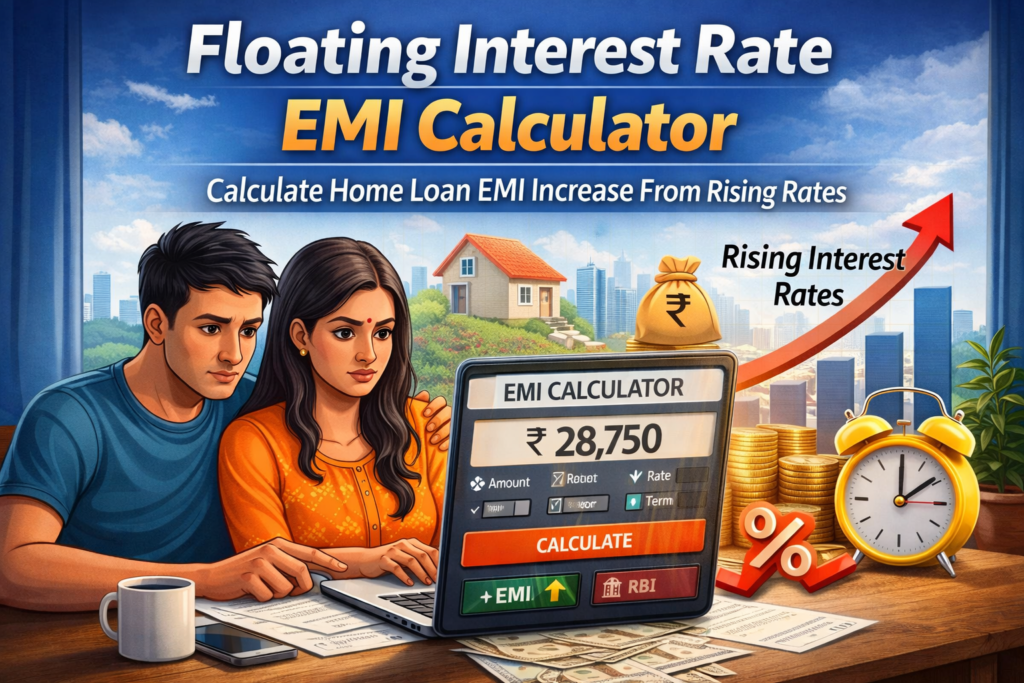
Most commonly, this benchmark is the RBI Repo Rate (the rate at which the central bank lends money to commercial banks). Under the External Benchmark Lending Rate (EBLR) regime mandated by the RBI, banks must link their retail lending rates directly to this public figure. To make their profit, banks add a fixed “spread” or margin on top of the repo rate. If you have an adjustable interest rate loan calculator handy, you can see how this spread heavily penalizes older loans.
If the RBI increases the repo rate by 0.50%, your bank will typically pass that exact 0.50% hike onto you, pushing your effective Return on Investment (ROI) higher. Consequently, the cost of borrowing increases, which forces the bank to either hike your monthly EMI or extend your repayment timeline.
The Math Behind the Chaos: Calculation Methods
Banks calculate your loan using the standard reducing-balance method. This means interest is calculated only on the outstanding principal at the end of each month, not on the original loan amount.
The standard EMI formula is:
EMI = P × r × (1+r)^n / ((1+r)^n − 1)
Where:
- P is the Principal outstanding.
- r is the monthly interest rate (Annual Rate / 12 / 100).
- n is the remaining tenure in months.
When the repo rate changes, the bank recalculates this formula using the new `r`. If you fall under the common “Keep EMI, Adjust Tenure” policy, the bank holds the EMI constant and solves the equation backward to find the new `n`. If the new `r` is significantly higher, `n` can expand drastically.
Reality Check: How RBI Repo Rate Hikes Hit Your Wallet
Let’s look at a concrete, jagged-data example. Suppose you have an outstanding balance of ₹38,15,500 with 15 years (180 months) remaining. Your current interest rate is 7.15%. Your EMI is ₹34,428.
The RBI announces a 1.25% repo rate hike cumulative over six months, rendering your new effective rate at 8.40%.
Scenario A: Adjust EMI (Keep Tenure Constant)
The bank recalculates your EMI for the remaining 180 months at 8.40%. Your new EMI jumps to ₹37,336. You must find an extra ₹2,908 in your monthly budget immediately. This hurts now, but it is mathematically cheaper in the long run.
Scenario B: Adjust Tenure (Keep EMI Constant)
The bank keeps your EMI at ₹34,428. Because the interest component now takes up more of that ₹34,428, very little principal is paid off. Your tenure stretches from 180 months up to 216 months.
You will be paying this loan for an additional three whole years, costing you lakhs in additional total interest paid to the bank. A variable interest rate EMI calculation exposes how rapidly long-term debt compounds against you during inflationary periods.
What This Does Not Measure: The Limitations
While a floating rate home loan calculator in India provides vital foresight, it fails to account for delayed bank execution. When the RBI cuts rates, banks are notoriously slow to pass on the benefit, sometimes delaying the reset by a full calendar quarter. Conversely, when rates hike, adjustments naturally seem much swifter. This asymmetry means standard calculators might project slightly optimistic savings during rate-cut cycles.
And there is a worse scenario to consider. In extreme hike conditions, if your fixed EMI becomes lower than the monthly interest generated by the new rate, you enter negative amortization. The loan balance actually grows every month. Standard tools may simply error out or return “infinite tenure,” hiding the severity of the financial hemorrhage.
Tactical Defense: How to Prepay and Manage Your EMI
The most effective defense against a rising floating rate home loan is strategic partial prepayment. Because floating rate home loans in India carry zero prepayment penalties (as mandated by the RBI), injecting lump sums directly eliminates principal.
If you face a 1% rate hike, dropping an annual bonus or matured FDs directly into the loan account forces the principal down. This neutralizes the higher interest rate, preventing your loan tenure from ballooning. It is highly advisable to monitor the RBI repo rate impact on EMI and initiate a partial prepayment the week your bank notifies you of a rate increase.
Frequently Asked Questions (FAQs)
1. What is a floating interest rate in a loan?
A floating interest rate is a variable interest rate that changes based on market conditions, usually linked to the repo rate set by the Reserve Bank of India (RBI). When the benchmark rate increases or decreases, your loan interest rate and EMI may change along with it.
2. How does a floating interest rate affect my EMI?
When interest rates rise, your EMI or loan tenure may increase depending on your bank’s default policy. Conversely, when rates fall, your EMI or total interest payable may decrease. Running a Home Loan EMI increase calculator helps estimate these exact monetary changes before they hit your account.
3. How do you calculate EMI for a floating interest rate loan?
EMI is calculated using the standard reducing-balance loan formula based on your current outstanding loan amount, the new interest rate, and the remaining tenure. When the floating rate changes, the EMI is entirely recalculated using the new interest reality.
4. Is a floating interest rate better than a fixed interest rate?
Floating rates are usually lower than fixed rates initially and can save you significant money when interest rates drop in the broader market. However, they carry inherent inflationary risk because EMIs may increase rapidly when market interest rates rise to combat inflation.
5. What is the difference between floating and fixed interest rates?
A fixed interest rate remains entirely constant throughout the entire loan tenure, meaning your payment never changes. A floating interest rate changes periodically based on benchmark rates such as the public RBI repo rate, creating a variable payment structure.
6. How often do floating interest rates change in India?
Most banks revise floating interest rates whenever the benchmark rate changes, often linked strictly to the repo rate. Depending on RBI policy decisions, this may happen multiple times within a single year or remain stagnant for long periods.
7. Can my EMI increase in a floating interest rate home loan?
Yes. If interest rates increase, your EMI may increase immediately, or alternatively, your total loan tenure may extend depending on your bank’s specific adjustment policy.
8. What factors influence floating interest rates in India?
Floating rates are primarily influenced by official RBI repo rate changes. However, inflation rates, broader economic conditions, individual bank lending costs, and general market liquidity also play a significant underlying role.
9. Can I switch from floating interest rate to fixed interest rate?
Many banks allow older borrowers to convert from floating to fixed rates. Be aware that they may charge a hefty conversion fee depending on the lender’s terms, and the fixed rate offered will almost certainly be higher than the current floating rate.
10. Is a floating interest rate risky for home loans?
Floating rates carry inherent uncertainty because interest rates may increase sharply. That being said, they are the industry standard for a reason, as they can also drastically reduce total interest costs when long-term market rates decline naturally.
11. What happens to my loan when RBI increases the repo rate?
When the RBI increases the repo rate, the commercial bank’s cost of funds goes up immediately. They pass this cost directly to retail borrowers by increasing the lending spread rate, resulting in either a noticeably higher monthly EMI or an aggressively increased repayment tenure.
12. How much can my EMI increase if interest rates rise?
The exact rupee increase depends entirely on your outstanding principal mass and remaining tenure. A 1% rate hike on a ₹50 Lakh loan with 15 years left can easily increase the EMI by roughly ₹3,000 to ₹4,000 per month.
13. Should I choose a floating interest rate home loan in 2026?
If you anticipate macro inflation cooling down and subsequent RBI rate cuts throughout the year, a floating rate is highly advantageous as your interest burden will naturally decrease without needing to pay any refinancing fees.
14. Which banks in India offer floating interest rate home loans?
Virtually all major commercial banks, including SBI, HDFC Bank, ICICI Bank, Axis Bank, and Bank of Baroda, predominantly offer floating rate home loans natively tied to the modern EBLR scheme.
15. Does prepayment help reduce floating rate loan interest?
Absolutely. Making lump-sum prepayments directly slashes your outstanding principal. This drastically reduces the compounding interest calculated in all subsequent months and effectively shortens your overall loan timeline regardless of current rate hikes.
Next Steps
Stop guessing the impact of repo rate changes. Input your latest outstanding principal, remaining tenure, and current interest rate into our floating rate calculator. Assess exactly how much extra interest your bank is preparing to charge you, and execute a prepayment strategy immediately.



Comment Guidelines